Play free online tile sliding number puzzle game and solve challenging levels by sliding the tiles to the correct numerical order. In this puzzle, the tile game is arranged within grid with one unfilled space.
What Is a Sliding Number Puzzle Game?
The sliding number block puzzle contains the numbered tiles which are placed within square grid. One space remains empty so that tiles can slide into it. This brain game puzzle identified by many names such as the 15 puzzle consists of four columns and rows (4×4 slide puzzle solver). It is also called Game of Fifteen, Gem Puzzle, vintage slide puzzle, tile game with numbers or sliding tile puzzle.
The goal is to move the math game slide and find all the number word puzzles in the correct order.
How to Play the Slide Number Moving Block Puzzle Game?
Play the slide-moving game. You need to place the numbered tiles in the correct order from smallest to largest by moving from left to right and top to bottom. One square remains empty and tiles can slide into this open space. Simply to move tile you need to click or tap it.
The number tiles move above, below, left or right in the blank area. The completion of the sliding puzzle game will be based on all numbers being in the correct order and the blank block positioned in the bottom-right corner of the grid.
Rapidworsearch slider puzzle also provides solver option that helps you automatically complete the puzzle when you are stuck or want to see the correct solution. Simply click on the “Solve” button and the system will rapidly arrange all tile numbers into the correct order. This feature is useful for learning how the puzzle works, understanding better move patterns or quickly finishing difficult round.
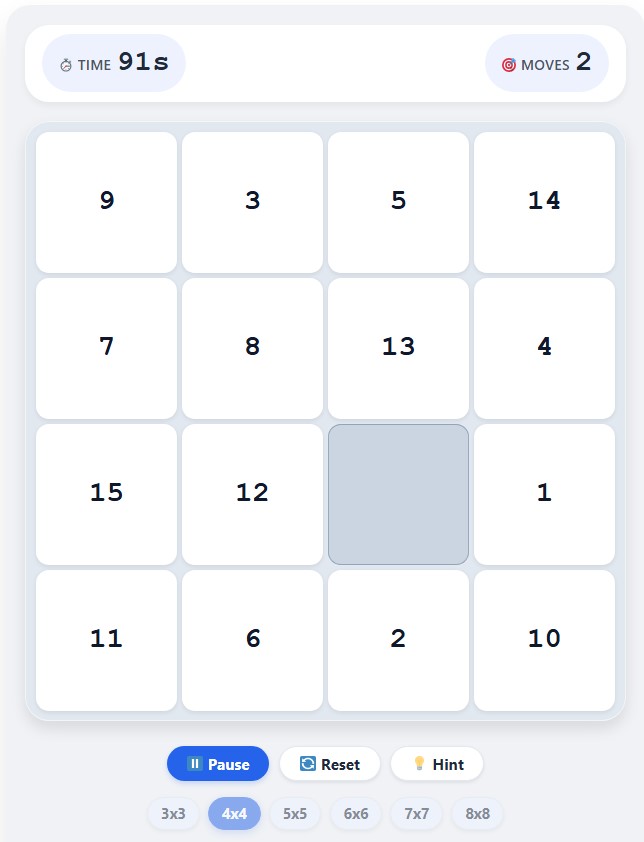
Different grid sizes of slider games
The game offers six different sliding number puzzle grids to challenge players of all skill levels. Choose the slide number block size from the top menu above the puzzle grid such as
- 3×3 Grid (9 tiles) – Beginner level
- 4×4 Grid (16 tiles) – Intermediate level
- 5×5 Grid (25 tiles) – Advanced level
- 6×6 Grid (36 tiles) – Expert level
- 7×7 Grid (49 tiles) – Master level
- 8×8 Grid (64 tiles) – Extreme challenge
Click the “New” button to reset the tile numbers in a different sequence. The timer does not start immediately, as it starts automatically when you make your first move.
Easy to hard difficulty level of the sliding number game
This number shuffle puzzle is generated through scrambling process that ensures the puzzle is always solvable. The sliding number puzzles will become harder as the size of the grid increases. However, puzzle difficulty also depends on the starting arrangement and position.
3×3 Sliding Puzzle
- Beginner-friendly
- Fewer possible positions
- Easier to learn
4×4 Sliding Puzzle
- Standard Fifteen Puzzle
- Requires planning
- Easy-to-medium level solutions
Larger Grids
- More difficult challenge
- More number tile combinations
- Increased solving time
Frequently Asked Questions
How does the number fill in slide puzzle move work?
- You can only move tiles that are directly next to the empty space.
- Moving number tile means sliding it into the empty space.
- The empty space then takes the position where the tile was.
- Use the arrow keys for quick moves Up, Down, Left and Right.
How to use the hint button as a sliding number block puzzle solver?
- Clicking the “Hint” button highlights the tile that is one move closer to its correct position.
- Each hint shows which tile should be moved next.
- Use hints to get unstuck when you are uncertain about the next move.
- Hints are used as many as you need.
How to solve a sliding number puzzle 3×3 or 4×4 grid?
You can use the “Solve” button as sliding block puzzle solver in the following ways.
- Use the Hint button to analyze which tile is close to the solved position
- Work row-by-row from top-left
- For the final 2×2 corner go rotating or using the Solve button to check the solution
- Each move counts so plan before sliding
- Do not randomize the number however use systematic approaches to beat random sliding
- Watch the blank block and think about where the blank needs to go
- Avoiding corners will keep the last row/column flexible until the end